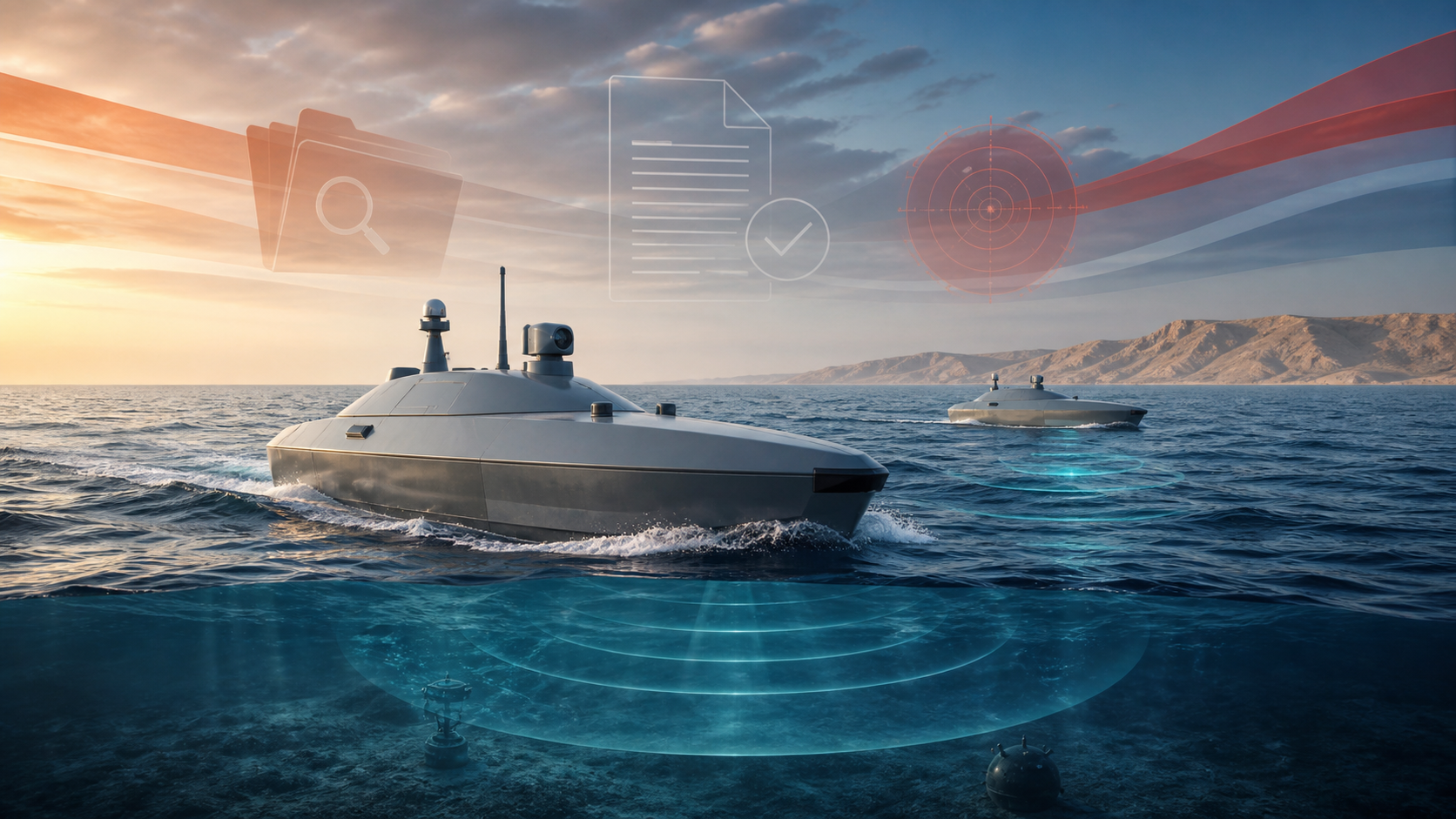
The Netherlands has approved a €13 million export licence for two autonomous surface vessels destined for Morocco’s Royal Navy after assessing whether the systems could be used in connection with the Western Sahara conflict.
In a letter sent to the Dutch House of Representatives, the government said the vessels are intended for anti-submarine and mine-countermeasure missions. It concluded that there was no clear risk they would be used for aggression against another state or to enforce a territorial claim by force.
The decision authorises the export; it does not establish that the vessels have already been delivered or deployed. The public documents do not identify the Dutch supplier or the model, citing the transaction in functional terms rather than disclosing commercially sensitive details.
What the €13 million licence covers
The export package includes two autonomously operated unmanned surface vessels, their sensors and control systems, spare parts, training and technical support. The Moroccan navy is listed as the end user.
The systems are designed to extend Morocco’s ability to detect submarines and locate or neutralise naval mines. Uncrewed vessels can operate in potentially dangerous waters without placing sailors directly inside a suspected minefield, while carrying sensors over longer missions.
The Dutch assessment describes the platforms as mission-specific and primarily defensive. It says converting them to substantially different roles would require major technical modifications. Any weapons fitted to the vessels would, according to the government, be limited to protecting the platform and supporting its anti-submarine or mine-countermeasure mission.
Why Western Sahara was part of the review
Dutch authorities assessed the application against the eight criteria of the European Union’s Common Position on arms exports. Their parliamentary letter focuses on criterion four, which considers regional peace, security and stability.
The letter notes that Morocco exercises de facto control over most of Western Sahara, including through the presence of its armed forces and naval activity in waters off the territory. It also recognises that Western Sahara’s international status remains disputed and is meant to be resolved through a United Nations-led political process.
The Netherlands concluded that Morocco’s existing military presence was not, by itself, evidence that these particular vessels would be used to enforce a territorial claim. The government argued that remaining confrontations with the Polisario Front are small-scale and land-based, with no meaningful maritime component.
It also cited the absence of an interstate maritime conflict or competing state claims at sea. On that basis, the review found use of the vessels in the Western Sahara conflict unlikely and gave a positive assessment under the regional-stability criterion. The other seven EU criteria were also assessed positively, according to the letter.
The assessment does not settle the territorial question
The export decision is a risk assessment tied to two specific systems, not a ruling on sovereignty. The United Nations continues to list Western Sahara as a Non-Self-Governing Territory whose final status remains unresolved.
Morocco considers Western Sahara part of its national territory and proposes autonomy under Moroccan sovereignty. The Polisario Front seeks independence. The United Nations Mission for the Referendum in Western Sahara, MINURSO, has operated in the territory since 1991, while the UN continues to call for a just, lasting and mutually acceptable political solution.
The Dutch government’s conclusion also does not mean that military exports to Morocco are free from scrutiny. It means officials judged the stated design, intended use and maritime context of these two vessels against the EU export-control framework and found no clear diversion or regional-aggression risk sufficient to deny this licence.
Morocco described as a strategic security partner
The letter places the transaction within a wider Dutch view of Morocco as a stable and strategic security partner on the European Union’s southern flank. It cites Morocco’s role in regional stability and in limiting irregular migration along the route from West Africa toward the Canary Islands.
However, the government explicitly says the autonomous vessels are not suited to migration-control missions. Their declared purpose is to strengthen specialised naval capabilities rather than patrol civilian migration routes.
For Morocco, the acquisition would add an uncrewed layer to existing ships and aircraft equipped for maritime surveillance. It would also address a recognised gap in mine-countermeasure capability while the navy considers broader modernisation projects.
What remains undisclosed
The public file does not name the manufacturer, specify a delivery timetable or identify the vessel model. It also does not reveal the exact sensors, autonomy software or protective armament included in the package.
Those omissions limit independent evaluation of the vessels’ full capabilities. What the parliamentary record establishes is narrower: a licence worth €13 million has been granted, the Moroccan navy is the end user, two autonomous surface vessels are covered, and the Dutch government completed a positive review under all eight EU arms-export criteria.
- Dutch House of Representatives — Government letter on the military export licence to Morocco, file 22054-489 (13 July 2026): https://www.tweedekamer.nl/kamerstukken/brieven_regering/detail?did=2026D36720&id=2026D36720
- OpenTK — Searchable text of Dutch government letter 2026D36720: https://berthub.eu/tkconv/document.html?nummer=2026D36720
- United Nations — Western Sahara listed as a Non-Self-Governing Territory: https://www.un.org/dppa/decolonization/en/node/703
- United Nations Peacekeeping — MINURSO fact sheet and mandate: https://peacekeeping.un.org/en/factsheet/minurso
- Bladi — Netherlands assessed possible Western Sahara use before approving Morocco naval-vessel export (31 August 2026): https://www.bladi.net/drones-militaires-maroc-pays-bas-examine-risque-utilisation-sahara,123476.html

The Morocco Report Newsroom
The central editorial team of The Morocco Report, an independent English-language publication covering Morocco for an international audience.